Companion Urns
A companion urn holds the cremated remains of two people together, often spouses or partners, in a single vessel. It's a meaningful option for couples who want to remain together after both have passed, but it comes with a few practical considerations worth knowing before you choose one.
How capacity works
Companion urns need roughly double the cubic inches of a standard single urn, since they're holding two individuals' remains. Most companion urns run 300–400 cubic inches, though the right number still depends on each person's size. See our sizing guide for the underlying math if you want to calculate more precisely.
Two ways companion urns are built
Single chamber urns hold both individuals' remains together in one shared interior space. This is the more traditional and common format.
Divided chamber urns have a physical separation inside, keeping each person's remains distinct within the same urn. This matters to some families for personal or religious reasons, and it's worth checking a product's description if that distinction is important to you, since it's not always obvious from photos alone.
When you're purchasing ahead of time
It's common to purchase a companion urn after the first passing, with space reserved for the second. In that case, the urn is used right away for the first individual, and the remaining capacity stays available for later. This is a completely normal and common approach, funeral professionals see it regularly.
Choosing a style
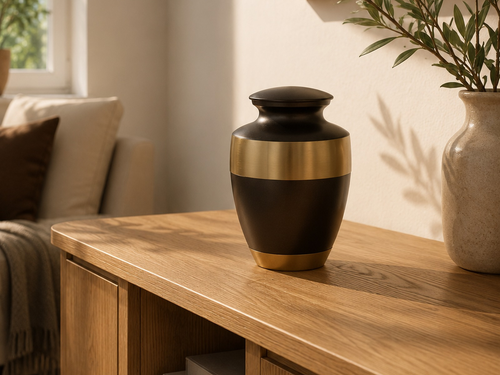
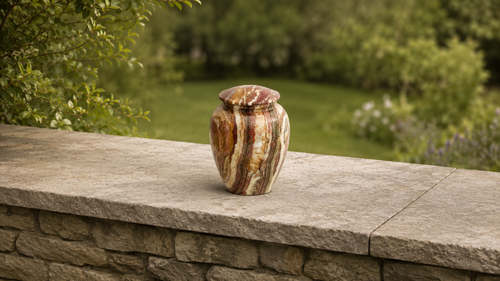
Beyond capacity, companion urns come in the same range of materials and styles as individual urns, wood, metal, and stone all have companion-sized options. The same durability considerations from our materials guide apply here too, so it's worth reading that alongside this one if you haven't already.
If you're navigating this decision, we know it often comes at a difficult time, made harder by needing to think ahead. Our team is glad to talk through the options with you directly if that would help.